
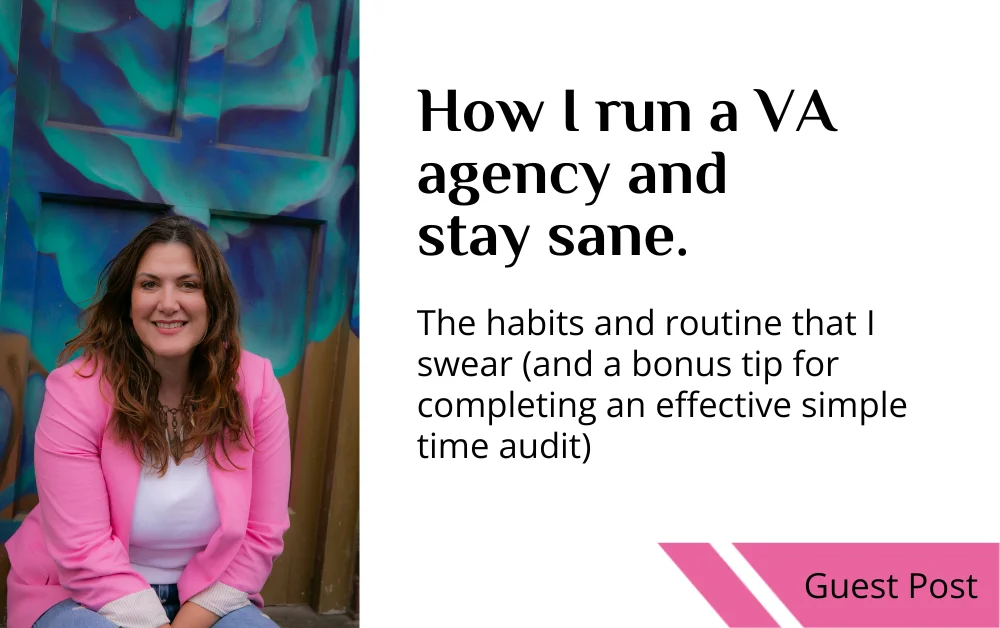
How I run a VA agency and stay sane. The habits and routine that I swear by (and a bonus tip for completing an effective simple time audit)
By Isabelle Pearcey, Founder of Izz Whizz VA
I’ll be honest with you: I did not always have this figured out.
When I started out as a solo VA nearly 4 years ago, I was juggling event management, board support, charity governance, trade mark paralegal work, legal EA support, multiple inbox management, and complex diary wrangling often all in the same day/week. I was busy in the way that feels super productive but really isn’t.
I was working hard and still ending each day with the niggling sense that the most important things hadn’t quite happened. Yes, my brain thrived on the variety but it’s not a sustainable way to live long term.
What changed was figuring out how to work differently, not more hours.
These are the simple habits that truly transformed how I operate – see what they might reveal about your own working week.
1. Templates for everything (including (especially!) on your phone)
If you find yourself typing the same things repeatedly, you’re losing time you’ll never get back. I know you’ve heard it before but if you don’t have them set up already, the time is now!
I have templates set up across all my devices including shortcuts on my phone that expand into entire paragraphs at the tap of a few characters. When a potential client reaches out to me on LinkedIn while I’m away from my desk, I don’t have to draft a response from scratch. A quick shortcut gives them everything they need: answers to frequently asked questions, how to book a discovery call, what to expect next.
Think about the messages, emails, and responses you send most often. Every one of those is a candidate for a template. The ten minutes you spend setting it up saves hours over the course of a year.
2. Do less, but actually do it
Here’s the mindset shift that made the biggest difference for me: stop writing a to-do list each morning of ten/twenty things and then feeling disheartened when you’ve only done four.
Focus on your three highest-priority tasks each day. Three things you will genuinely complete or that will move the needle. Not a wish list – a commitment list. I like to keep a small notepad in front of me with the three biggest things I’m going to do that day. In plain sight, it serves as a continuous reminder and it’s so satisfying to physically tick things off at the end of each day. Old skool but true!
Being realistic about what’s achievable doesn’t make you less ambitious.
It makes you more effective which makes you more effective.
And there’s a happy little side effect: when you’re forced to choose just three priorities, you see more clearly which tasks probably shouldn’t be on your list at all because they belong on someone else’s.
3. Task batching: stop the context-switching
The research backs this up, but I discovered it through trial and error. Context-switching aka jumping between completely different types of tasks throughout the day costs you more than you think. Every time your brain has to shift gears, there’s a mental payment.
The solution is simple: group similar tasks together.
Do all your calls in one block. I pick Tuesdays and Thursdays so no one ever waits more than a day or so for a call with me and I can be in the right mindset for calls rather than jumping from a system or document between calls.
Plan and write all your content in another.
Handle your finances in a dedicated session.
Once you’re in the zone for a type of thinking, stay there.
For me, this also meant narrowing the range of services I offered, so I could serve clients at a deeper level rather than being competent at everything and not finding opportunities to really deepen my expertise to the next level. That discipline changed everything.
It also ultimately led to my business expansion where I have a curated team of associates who are skilled across all of those areas I used to handle and more besides…
4. Same thing, same day
Alongside task batching, I schedule recurring tasks and certain types of work on consistent days. Meetings happen on Tuesdays and Thursdays. Inbox checks happen at set times, not as a constant automatic reaction.
This might sound rigid, but it’s actually the opposite. When you know that calls happen on certain days, anyone who needs to book with you doesn’t wait long and your focus days stay protected. When routine tasks are anchored to specific times, they stop competing with everything else for your attention. You’re not deciding when to do them; the decision’s already made.
It removes an entire layer of daily mental load, and that matters more than people realise.
5. Colour-code your calendar
A small change, but possibly my personal favourite.. I love a pleasing aesthetic!
When I look at my diary, I can see at a glance what kind of day I have ahead; client calls in one colour, internal work in another, client work, personal commitments in a fourth. No reading required. Just a quick visual read of the day.
If you use Google Calendar or Outlook and you’re not already doing this, try it for a week. It’s one of those changes that feels minor until you notice how much clearer your head feels.
6. Build in fluidity – it’s really not a perfect science
Truthfully, I don’t follow all of this perfectly every day, and I’m not trying to.
The point of having structure isn’t to be rigid. It’s to give yourself a framework you can return to when things get disrupted and things Always Get Disrupted.
When a priority comes in unexpectedly or something runs over, I can move things around without losing the thread, because the thread exists in the first place.
Think of it less like a timetable and more like a scaffolding. It holds things up; it doesn’t box you in.
7. Track your time for two weeks (you might be surprised)
This is the one that tends to make people uncomfortable, which is exactly why it’s worth doing.
Spend two weeks using a time-tracking app (Toggl is a good free option) and record honestly where your hours are going. All of them.
Most people who do this are genuinely surprised by what they find. Not because they’re wasting time, but because the distribution is different from what they assumed.
Here’s a useful benchmark: if more than 20% of your working hours are going on admin, inbox management, scheduling, or general operational tasks, that’s a strong signal that outsourcing could meaningfully free you up. Not just to do more, but to think more clearly, make better decisions, and actually lead and nurture your business rather than running its back office and drowning in tasks that don’t move the needle.
What this has to do with me
I run a VA micro-agency. Of course I’m going to mention that delegating to the right support can change your working life but I also genuinely believe it, because I’ve seen it happen again and again. And it’s worked for me too.
Delegation doesn’t have to mean a VA. It might be a bookkeeper. A cleaner for a few hours a week. A one-off gardener once a month. The principle is the same: look honestly at what’s draining your time and energy, and ask whether it actually needs to be you doing it.
When you do start thinking about VA or operational support, it helps to know that good teams usually specialise. There are VAs who focus on creative and social media, others on legal and compliance admin, others on executive and inbox support, the list goes on – VAs are skilled across so many areas. A good VA will also help you work out where to start and will help you lighten the load gradually and sustainably, not overwhelm you with a handover.
At Izz Whizz VA, we become a natural extension of your business. We’re invested not just in the smooth running of your business, but in your wellbeing and in helping you operate as the best version of yourself, at a pace that’s sustainable.
If your two week time audit reveals that more than 20% of your hours are going on admin, let’s have a conversation.
I’d love to help you think through where to start. Book a no-pressure chat in my diary here
Isabelle Pearcey is the founder of Izz Whizz VA, a UK-based virtual executive assistant and operations micro-agency supporting founders and legal entrepreneurs. We are ICO registered and fully insured.